Monday, March 17, 2014

Brazil travel log, part 1: Of Cacao, Cocaine and Piranhas

"98% of the population does not work on cocaine," our affable guide in Bogota reassured us. My wife and I looked at each other, and doing some mental math I figured that meant about 1 million people still rely on the white stuff for their livelihood. Chewing coca leaves crushed with lime (powdered calcium hydroxide) was a popular ancient Indian tradition in Columbia that is now marginalized. Hot chocolate was on the other hand reserved for high ranking tribe members, but is nowadays a widespread practice amongst all Columbians. I refer you to this excellent article for more details on making Columbian Hot Chocolate.

It's easy to see why people in Bogota like hot chocolate: it's cool and damp all year round. After a 600m funicular ascent of Monserrate, you're 2 miles (3,200m) above sea level, and you can see from that vantage point many greenhouses dotting the cityscape. As it turns out, Columbia is the world's largest producer of roses. Chocolate and roses seem like a natural match, don't they? (By coincidence, we were there on Valentine's Day)
Ancient Indian coca-chewing selfie (Bogota Gold Museum)
A less natural match in my mind is hot chocolate and cheese, but that's the tradition here. The cheese imparts a slight saltiness to the chocolate that isn't really unpleasant, but doesn't enhance either. The cheese settles into a gooey layer at the bottom, but made me think that an interesting gringo take on this could be emulsifying cream cheese into thick hot chocolate. E-mail me to find out where you can send the royalty checks.
Monserrate, the massive Gold Museum, the Botero Gallery, and the street art are all attractions worth seeing in this still quite pre-touristic city, and they can be done in one day by an industrious traveller. Indeed, Bogota was only an extended layover for us, as we were making our way down to the Amazon Rainforest.
Chocolate Santafereño: cacao + panela (raw cane sugar) + salty fresh cheese mixed in. Arepa bun for dipping.

With its headwaters in Columbia, the Rio Negro is poetically as black as coffee. It winds its way down to Manaus, Brazil where it meets the muddy brown Rio Solimões to form the Amazon River. At "The Meeting of the Waters" a peculiar thing happens: the rivers run next to each other downstream for many miles without mixing. This is because of the different speeds, temperatures, turbidities and acidities of the rivers. Starting in Manaus, we did a three day boat trip up the Rio Negro. Our guide happened to own a small chocolate factory in town (Sweet Manaus), and I suggested a two sided caramel-chocolate log in honour of this phenomenon. Just waiting for this to show up at Trader Joe's and the like.
The Meeting of the Waters

The Amazon Basin not only has cacao trees, but is also its cradle, with a recent study showing 9 of the 10 varieties found here. That's right, forget Criollo vs. Forastero, the tremendous biodiversity of the Amazon extends into cacao too, and has yet to be really exploited.
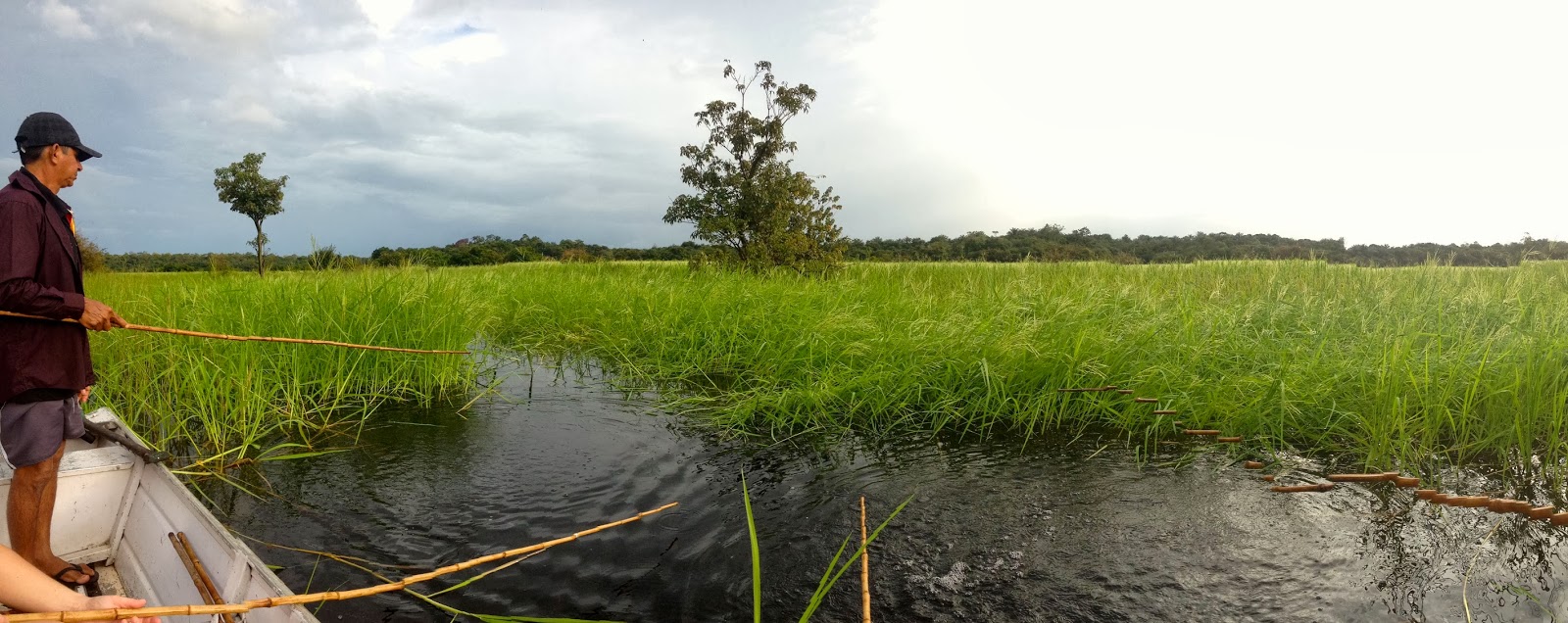
Fishing for Piranhas on the Rio Negro, Amazonas
The boat's cook gave us a great sense of the local home cooking. Not surprisingly fish predominates (a local favourite is Tambaqui), and it was all delicious, even the piranhas we caught ourselves one morning. Unbeknownst to me, piranhas are omnivorous (eat plants too), and play an important ecological role as scavengers. What also surprised me was finding out that the delicious juice we were drinking with our fish was the fresh fruit pulp of the cupuaçu, a tree that's in the same genus as cacao. The sweet juice tasted a bit like ya pear with a tinge of green mango.

Like cacao, it has pods filled with beans that are covered in quick spoiling white pulpy deliciousness we never get to experience living far from the equator. And it's very common in these parts. "That's what I make my chocolates with" our guide said. Cupuaçu seeds have the same desirable body-temperature melting fats as cacao, but processing it is a finnicky cottage industry, so you'll probably not see many cupuaçu candy bars lining North American store shelves until the superfood marketing people burn out on açai.

And yes, you do see wild açai everywhere in the forest. Crossing another Amazon stereotype off the list, we ran into several Brazil nut trees. I always though that opening a Brazil nut was really tough. It turns out we have it easy. 
A pitcher of juice from the cupuaçu,‎ cacao's kissing cousin
Our native guide spent about 3 minutes wielding a machete to open up the double-walled shell that encases 20-22 of the hard shell nuts that we tend to see around Christmastime. Right off the tree, the nuts taste surprisingly similar to fresh coconut. Sweet Manaus makes candies with Brazil nuts, though ironically, the nuts aren't all that popular in Brazil...at least amongst humans. You may wonder how such a tough nut would ever get planted, and the answer is agoutis. These rodents (which eluded us on our forest walks) love cracking open the tough outer shell and feasting on the insides. In case you're worried about all those first world pet agoutis missing out, I met a girl once who's Master's thesis was developing an agouti toy to simulate opening a Brazil nut shell. Yep, first world problems.
Brazil nuts: an agouti's delight

As we traveled through the rest of Brazil, one thing was obvious: Brazilians love their sugar. They make a gajillion pounds of it, and consume it too (as food and converted to ethanol fuel). Sugar cane loves lots of sun, and vast tracts of inland rolling hills are covered with the stuff. Cacao on the other hand is a rare shading loving fruit tree, which explains its natural niche under the rain forest canopy.
Sugar cane fields, Pernambuco State
The Amazon isn't the only rain forest in Brazil, and during our travels I was intent on visiting the Atlantic rain forest of the Bahia state, down the so-called Cacao Coast. Once upon a time this area supplied close to 15% of the world market for cacao. The heyday of this area was the 1930's, and a slow decline due to cultivation globalization was accelerated in the 1980's by an unwanted Amazonian visitor: a bacterium that causes Witch's Broom. The bug causes rapid abnormal non-fruiting branch growth, and the branches eventually loose their leaves and looks like a witch's broom.
Nevertheless, there is still cacao, and I needed to see it. After a 3 hour queue in 42°C on the Salvador dock, then a 1 hour ferry ride, then a 40 minute delay while they fixed the gate, then 3+ hours of harrowing driving on somewhat paved roads, we ended up in the laid-back town of Itacare, where marmosets watch surfers from trees at the junction of the dense rainforest and the Atlantic Ocean. From there, Alan gave us a 1 hour Land Rover ride over a washed out dirt road to get to Vila Rosa. Alan is a transplanted New Yorker on a self-described Quixotic mission to restore an old cacao plantation to its 1930's splendour. By my reckoning, the restoration of Vila Rosa has definitely been worth it. Most of the other cacao plantation houses in these parts have succumbed to the relentless forces of nature over the years. 
The epic car journey to the Cacao Coast
Besides spending about 10 years painstakingly rehabilitating the building into a living museum, Alan has used his background in landscape design to harness and transform those natural forces into stunning environs for the house. He has built a kayakable reservoir, cascading waterfalls, a diveable pond, and deftly curated the native plants (the area holds a world record for vegetal biodiversity) with landscape classics. Floating in the shade of a Sombrero tree, rotating my gaze between the banana tree, a mottled frog and the birds circling high overhead, I felt that particular serenity you only get from being unplugged from the modern world and absorbing the spectacle of nature all around you.
Vila Rosa: restored plantation from Brazil's cacao heyday
Vila Rosa is just getting into the pousada (B&B) business, but with full board. In addition to good home cooked food, we were able to try a multitude of fruit juices from the estate. If you recall, cacao is a rare shade loving fruit, and the forest canopy around Vila Rosa includes about 40 different types of fruit trees. Growing quality cacao in a responsible way and paying workers respectable wages is not a great money making proposition. Doing a tour through the estate, it's obvious that more than being a cacao farmer or inn owner, Alan is a steward of the land.

Various approaches are used to combat witch's broom here, from selective replanting to grafting new plants onto old Criollo stock. We crack open a ripe pod (a bit hard to find at this time of year, though each tree has its own mind about this sort of thing), and pluck date-sized fruits from inside to suck on. While we enjoyed cupuaçu juice in the Amazon, cacao pulp is even more delicious, tasting quite a bit like lychee, with distinct floral notes and a touch of acidity as you'd get from a not-quite-ripe nectarine.
Cacao: pod + pulpy bean-containing fruits
The harvesting season lasts almost 9 months, and while we were there during the lull we get a walkthrough of the equipment for and logistics of producing market-ready cocoa beans: fermentation and drying. The cacao pulp is pressed out and saved as juice before fermentation (which both builds the flavour of and prevents germination of the beans). A clever retractable roof over the sun drying bed reduces the potential for spoilage and makes it double as an all-weather veranda for guests. We husk and taste a bean straight from the drying bed, and it's remarkably palatable compared to the "superfood" cocoa nibs I've tried in North America.

We also get a walkthrough of the process to transform dried cacao beans into chocolate, as there is a demonstration scale factory on-site to do the roasting, husking, grinding, and tempering. I can't do this process justice here (e.g. explaining the importance of Form V crystal structure), and would suggest any Alberta readers to attend the excellent Chocolate Snobbery 101, where in fact one of the single-origin chocolates uses beans from the same region. Other readers interested in Bahian origin chocolate may have luck internationally finding the products of Alan's friends at AMMA Chocolates. Personally I liked the 45% cacao most.
We gave the three resident black Labradors a goodbye petting, left Vila Rosa and started to wind our way back to Salvador to catch the start of Carnaval celebrations (a post for another day).

I've always appreciated good chocolate, and our travels in Brazil made me appreciate cacao's birthplace. Here the tree is part and parcel of the biodiverse landscape, and it's a lot of work to sustain. Brazil now accounts for only about 5% of world cacao production, having given way to increasingly monoculture-like farming practices in equatorial Africa. Echoing a sentiment we heard often across the country, Alan lamented "everything in Brazil is hard". But doing it right was well worth it.

Thursday, March 6, 2014

Concert Alert: Ruthie Foster & Charles Musselwhite

I generally hate concert previews, but am going to write a brief one anyway. You see, I had the privilege of seeing Ruthie Foster's group play an intimate gig in the candlelit cellar of the Okanagan's Blasted Church winery in 2009. Although virtually no one there knew her before that night, the entire audience was in blues communion by the time the concert was over, swaying and swooning. Infused with gospel and soul, her inimitable voice makes contemporary blues easily resonate even with people who don't follow the genre. Some musicians record great studio music, but fall flat live. Double-billed with blues journeyman Charlie Musselwhite, the upcoming concert is about as surefire a concert bet as you can get in Calgary.

Foster and Musselwhite play the Jack Singer concert hall March 19th, as part of the BD&P World Music Series. Tickets are available via the EPCOR Centre Box Office.

Friday, February 7, 2014

Muse: Exposure Photo Fest


In Greek mythology, the nine daughters of Zeus and Mnemosyne presided over the arts and sciences: they were called the Muses. Muse is also a collaborative photo exhibition. The title for the show is appropriate, as the thread that connects the works of the 9 artists are the human subjects that inspire them. The works themselves are otherwise very diverse, from polaroids, to boudoir tintypes, to large format digital compositions.

The opening was packed, and there was a preponderance of lanky photobug types, but I think the diversity of the works in a single room means that even the most casual gallery goer will find something to ponder. And hey, looking is free, so why not go for half an hour and see what these works evoke in you? With no intention of abasing the other artists, here's what piqued my interest most:

- Lucky I Got What I Want. A carefully arranged set of 15 or so framed photos taken in and around a wintery log cabin, Lori Andrew's piece is visual poetry. Rhythmically alternating in subject between inanimate objects and a woman, the photos almost beg the viewer to build their own narrative. Why did the woman put on a green dress? Is she waiting for something/someone while prone on the sofa? WHAT DID SHE WANT, DAMMIT?! As the artist started to explain the collection to someone, I ran away so she wouldn't ruin my own interpretation.

- The two Wallflowers. For me, Colin Way's contemporary portraits of women cleverly evoke the kind of non-perspective Virgin Mary iconography you see in Orthodox churches. While the clothes have been (I assume) digitally flattened to match the wallpaper, the skillful styling of the hair and the makeup do so to. Is there a subtle commentary here for those somewhat familiar with the history and role of religious art? I'd like to think so.

- Blacksmiths. Dan Bannister's unframed photo collection of smiths and hand crafted iron objects has a documentary quality to it.  I like the subtle smile of one smith, and the faint weariness of another... these muses punctuate the muted tones of the collection. Cradling their wares in their deeply creased and sooted hands, the visceral connection between the makers and their works soothed me in the age of Aliexpress.

- This World is a Veil (I-IV). The type of work that makes you appreciate how much more there is to photographic art than taking pictures.  I still haven't figured out what all the objects were in the shots, or how Julya Hajnoczky overlaid them.  The background human forms juxtaposed with these emerging objects left me staring at them in reflective thought..musing, if you will.

Muse runs through February 20th at Studio 122, located at 4029 8th Street in the industrial core of Calgary's South East.


Wednesday, February 5, 2014

The Huron Bride

Fear of the unknown is amongst the most primal of fears. Historically set in the remote forests of Upper Canada, the Huron Bride is effectively an educational piece disguised as a scary ghost play. The haunted mill backdrop superficially sets the horror tone, with suitably moody lighting (often only a single portable lamp) and sound effects. The plot is boilerplate and predictable, which will leave ghost story aficionados rolling their eyes as there is no unknown, and hence no visceral fear for the audience to experience except the odd crashing prop.

We may have seen the plot in broad strokes before, but the strength of the script is in craftily painting a picture of personal life in rural Ontario nearly two centuries ago. This is the real unknown for the average audience, for whom I'm guessing CBC's Murdoch Mysteries commercials are the primary source of period Canadiana.

With the exception of the male lead flubbing a few lines and delivering others reminiscent of the bearded priest in Little Mosque on the Prairie, the cast successfully conveyed the hardship, as well as the social tensions and conventions of the time. I might not have been scared, but was thoroughly creeped out by Leanne Govier's performance as the troubled half-Indian child Lyca. 

I somewhat enjoyed The Huron Bride, but it's more like I appreciated it. Especially given that Vertigo is offering $25 seats in the back rows, which we took advantage of. Now that your fright expectations and costs have been managed, you can go learn about but not fear the historical haunted hinterlands at Vertigo Theatre through February 23. 

Friday, January 31, 2014

The Walrus Talks: "Tomorrow"


Always a highlight of the OYR High Performance Rodeo, The Walrus Talks are 8 x 7 minute thought provoking talks from a wide range of speakers from many disciplines. Missed it?  Be sure to get your tickets early next year for this sold out event at the Jack Singer!

While the talks are not coordinated with each other in any way, they all revolve around a theme, and this year it was "Tomorrow". It is said that the sign of a great intellect is to be able to hold two equal yet opposite ideas in one's mind at the same time. Upon reflection, there were certainly dichotomous viewpoints in the Walrus Talks. At the same time, surely thought-provoking talks are meant to spur on transformative action. Here's what I gleaned from the speakers, about how we as audience members (and now you as readers) can take action to transform the future...

Neil Turok had the Herculean task of explaining to laymen the implications of moving from the digital age to the quantum age in the next 15-20 years. The benefit will be that our capacity for computation and memory will not grow exponentially, but virtually infinitely. 
A real "quantum leap".

At the other end of the scale, author Joseph Boyden warns us to pay attention to all the incremental changes we are subjected to. "Creeping normalcy" lends us to accepting situations we would have found intolerable if presented to us all at once (e.g. the Canadian government's singular focus on being a petro-state).


Ad guru Terry O'Reilly makes us aware of how The Internet of Things is incrementally becoming a reality: there are billions of two-way devices (including cars) right now that not only tell you information, but also send it back to The Mothership. Some of this is about better customer service, but nefarious uses are all too easy to imagine as well.

Ace app developer Michael Sikorsky is more sanguine, sure that innovations will eliminate the need for people to have singular focus on their handheld devices (e.g. the awkward silence at dinner tables everywhere these days as people type away). Throughout history, as devices improve in scale and speed, they allow us to communicate more easily.

Dual-citizen Diane Francis explained that the US is our natural partner, with whom we should forge an ever closer union to fend off foreign interests.  The world won't let us sit on our under exploited natural resources for much longer. We must exploit them before others do.

Survivorman Les Stroud in contrast contended that we are in a state of environmental slavery, and it will be as unethical to our grandchildren as human servitude is today. A palpable shudder emanated from the audience as he challenged us to take our garbage cans away for a month. As he explained that everyone leaving their packaging at the store counter would cause businesses to transform their distribution model, a lot of LED bulbs went off in people's heads. 

The amazing Shad closed with free versed...
The future is uncertain, and we fear what we don't know. Don't be afraid to act though: it's less important that we take the right actions, and more important that we know they come from a pure place. "Intelligence is not a virtue...I never regret the stupid things I've done, but I do regret the cowardly and selfish things that I've done."

Did the Walrus talks give me a definitive answer about the future? No, but I am less afraid to act.


Friday, January 24, 2014

Craigslist Cantata: Alberta Theatre Projects

In music, a sonata is a standard framework where you start with a theme, then wander off, then return to the theme for closure (the so-called "ABA" pattern). Craigslist, albeit a Cantata, opens with the theme of Missed Connections, where we can laugh at the foibles and insecurities people have, as laid bare in the classifieds. For sure, there are plenty of laughs to be had as the actors sing the ads verbatim, but with much affectation and clever prop use. 

We see the fore lorn ad writers from a comedic distance, but things change as the Cantata wanders into the B theme of Items Free To A Good Home. Here we continue to laugh, but there is also genuine pathos for the real people behind the odd ads. Whether they are letting go of many hats from their beloved ex-cat, or are cathartically dumping their adolescent stuffed penguin collection, Craigslist is a window into their personal drama. 

Mustering the courage to publicly rid oneself of objects stuck in the past is potentially a deep subject to explore, even comedically. This was perhaps a missed opportunity. The Cantata inevitably draws back, trying to get closure in the form of a saccharine but very catchy and well sung Missed Connections ensemble piece. 

If Rent's "525,600 Minutes" pulled at your heart strings, so will Craigslist Cantata's 80 minutes songbook. For those who want a High Performance Rodeo show to challenge them, check your intellect at the door and enjoy a good laugh with everyone else. The oddness of real life virtually guarantees it.

Craigslist Cantata runs through February 1st at the Martha Cohen Theatre as part of One Yellow Rabbit's High Performance Rodeo.

The Calgary Philharmonic Orchestra's Tweet Seats

When I here the word "tonic", I think of gin rather than the reference pitch of a piece of music. I'm guessing I'm not the only one, so it's nice that the CPO has started a designated balcony section called "Tweet Seats". This is where smartphone addicts like me can be edified by CPO staff over Twitter during the concert. The Tweet Seat pilot is taking place during the CPO Rush Hour series, which are 1(ish) hour after-work concerts, each one built around a theme. Last night, it was Beethoven and his Viennese contemporaries.

Katherine Duncan (host of CBC Radio's Key of A) talked at length with conductor David Lockington before and between pieces, so the whole audience learned about the historical context of the music, such as rivalries, influences, and Napoleonic occupation. The audience also learned about the challenges the concerto soloists face (Clarinet:Steve Amsel, Trumpet: Adam Zinatelli).

In the Tweet Seats though, we were further enriched during the music by @CPORush (Artistic Director Heather Slater for this concert).  What I appreciated most were the tweets telling us the structure of the piece, and what part was coming up, what to listen for, how the parts relate, etc. Counterintuitively, using my phone made me pay more attention to the music. My mind has been known to drift off a bit at concerts previously...

Thankfully, there were relatively few navel-gazing tweets from the people in the Tweet Seats, mostly kudos for the soloists, and questions about the music, which were prompt answered. The back and forth effectively demystified Beethoven for me, and I hope they make Tweet Seats a permanent fixture.

The next concert in the CPO Rush Hour series is Friday, May 30, 2014, with music from Stanley Kubrick's classic sci-fi film 2001: A Space Odyssey. If I'm lucky, they'll also demystify the meaning behind the giant in utero fetus floating above Earth.